
What Irwin Tax Records Show
Two offices divide the work in Irwin County. The Tax Assessor appraises each parcel, maintains the assessment roll, processes exemptions, and takes the first round of value appeals. The Tax Commissioner then bills and collects the tax, records payment status, and runs delinquency and tax-sale steps. A single parcel number ties all of it together.
| Field | What It Shows | Where |
|---|---|---|
| Fair market value | Assessor's estimate as of January 1 | Tax Assessor |
| Assessed value | Generally 40% of fair market value | Tax Assessor |
| Exemptions | Approved reductions or special treatment | Tax Assessor |
| Bill and status | Amount billed, paid, or delinquent | Tax Commissioner |
| Tax sale trail | Execution, notice, advertising, and sale stages | Tax Commissioner |
Georgia assesses most real property at 40% of fair market value. A special rule applies in some cases. Exemptions and preferential programs can lower taxable value further. The final bill folds in millage rates and other lawful charges. None of these figures simply equals a recent sale price.
Irwin Property Tax Value Date
The official tax guidance is preserved in the captured page below.
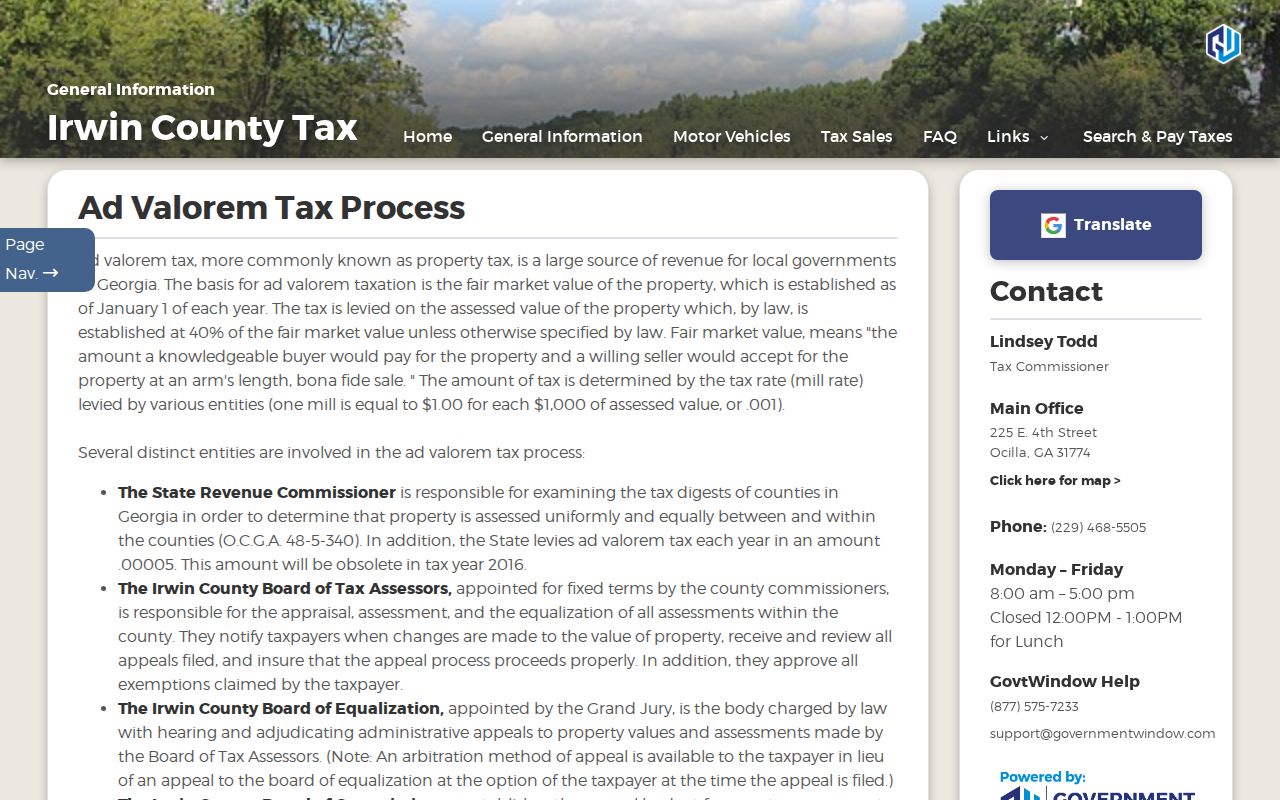
Real property in Irwin County is assessed from January 1 each year. That date is the value snapshot. So a deed recorded later is on one clock. A tax bill issued for the same year can sit on another entirely.
Compare the deed recording date, the assessment year, and the bill year side by side. Add the payment status too. The county does not publish a fixed delay for changing the tax-card owner. A newer deed paired with an older roll name usually reflects timing, not an error. Note: check with the tax office before treating any mismatch as proof of a mistake.
Irwin Property Tax Office Roles
Treat the Assessor and the Commissioner as two desks, not one. Fair market value, assessed value, exemptions, and notices of assessment belong to the Assessor. The amount due, payment, delinquency, and tax-sale questions belong to the Commissioner.
Tax Assessor
225 E. 4th Street, Ocilla
Parcel cards, appraisal, exemptions, and assessment appeals
Tax Commissioner
225 E. 4th Street, Ocilla
Bills, collections, delinquency, and tax-sale process
For current phone numbers and office details, the county's official contact directory is the dependable source when a third-party portal fails to load.
Look Up Irwin Property Tax
Irwin County points to Government Window for online property tax search and payment. The application may block some visitors, and its exact search fields for Irwin County are not published elsewhere. Confirm the owner, address, bill number, and prior-year controls on the live screen before relying on them.
- Start with the parcel ID from qPublic and open the official tax portal.
- Use only the fields displayed, then save the tax year, amount, and dated status.
- Compare the bill with the Assessor's value and exemption fields for that year.
- Ask the Tax Commissioner for a ledger when prior years or delinquency stages are unclear.
- Assessed value
- The statutory share of fair market value before later adjustments.
- Millage
- A rate used to calculate tax from taxable value.
- Homestead exemption
- Application-based relief for a qualifying home.
- Tax execution
- A recorded collection claim arising from unpaid tax.
Irwin Property Tax Delinquency
Irwin County sets December 20 as the real-property due date. Once an account goes delinquent, the path can run through interest and a tax execution known as a FIFA. Added charges may follow. The account can then move to Georgia Tax Solutions, newspaper advertising, and finally a tax sale. Read the date and stage on every notice you receive. The official tax-sale page is the county's notice route. It does not always carry a current sale list. A tax execution or an ad is not a certificate of clear title. Redemption rights, the eventual deed, other liens, and court records can all still matter.
Irwin Property Tax Exemptions
The county describes homestead, senior, disabled-veteran, surviving-spouse, and other statutory programs. Eligibility turns on the law and a timely application. A program named in general guidance does not mean approval for any particular parcel. Agricultural, conservation-use, historic, brownfield, timber, and similar preferential rules can also shift the value. They can also shift the taxable base. Note: Record the program, covenant period, application record, and tax year instead of guessing from how the land looks on a GIS map.
Irwin Property Tax Mobile Homes
Mobile homes run on a separate track. County guidance lists April 1 as the tax due date. It also describes a permit or decal, penalties, and an appeal sequence of their own. A mobile home and its land can appear in one search result. Identify which account and tax year each figure covers. Keep the April calendar apart from the December 20 real-property date.
Request Irwin Property Tax Ledgers
When the online portal is blocked or lacks the year you need, ask the Tax Commissioner for a parcel-specific bill or ledger. Include the parcel ID, site address, owner name as displayed, tax years, the payment or delinquency fields you want, an electronic format request, and a fee-estimate request. Ask the Assessor separately for certified roll data, parcel cards, exemption records, or historic value records. Georgia Open Records Act requests may be oral or written, though writing preserves the scope. Agencies generally respond within three business days unless an exception applies.
Appeal Irwin Property Tax Assessments
An assessment appeal targets value, uniformity, or taxability, not general unhappiness with a bill. The county gives taxpayers 45 days from the notice of assessment to appeal. The notice itself controls the deadline and filing instructions. Build the file with the parcel card, the notice, comparable property evidence, photographs, and any relevant deed or sale records. Include corrections to property characteristics. Keep proof of timely filing. The Board of Equalization handles the assessment dispute. Payment questions stay with the Tax Commissioner.
Watch the notice date. The Irwin County appeal period is generally 45 days from the assessment notice. Follow the current notice and statute.
Four Irwin Property Tax Dates
One parcel can show four useful clocks. The deed carries an execution date and a recording date. The assessment uses a January 1 value date plus a stated roll year. The tax bill belongs to its own billing year. Payment or delinquency gets a still later transaction date. Line those dates into a short chronology. Do not treat the latest record as a complete history.
A deed may follow the January snapshot. The tax-card owner may not yet mirror the newest grantee. Irwin County publishes no fixed update interval. No page can promise how many days a name change takes. Ask the Assessor for a current card or update statement when timing controls the answer.
Values deserve the same care. Fair market value is the appraisal starting point. Assessed value is generally 40% of that figure under Georgia's rule. Taxable value can shift through an exemption or a preferential program. The bill then applies millage and charges. A recorded sale price is a separate field. It may not equal any of these numbers.
Read Irwin Property Tax Sale Evidence
A delinquent bill, a tax execution, an advertisement, an auction, and a tax deed are separate stages. Write down each record's date and exact label. The Tax Commissioner's general information walks through the sequence. It covers interest, the FIFA, added percentage charges, Georgia Tax Solutions handling, advertising, and the sale itself. That page is the proper local notice route.
Never treat a sale alone as an ownership change. Locate the resulting deed in GSCCCA and check its legal description. Redemption rights, other liens, and court action can all change the outcome. A newspaper ad or a portal status can never substitute for that recorded instrument or for professional title review.
The same boundary protects owners and researchers alike. False fraud claims often fade once you see that qPublic, a bill, GSCCCA, and a notice serve different dates and functions. Record what each source says. Ask the responsible custodian for the primary document. State the uncertainty plainly whenever the chain of records stays incomplete.
Keep a sheet of market, assessed, and taxable values. Add the millage or amount and the current status. Include the source date and URL too. Leave any field blank when the source does not expose it, and record the newest grantee separately so a tax value is never mistaken for a sale value.
Program status also needs proof. Historic designation, preservation review, and preferential tax treatment differ. Agricultural and conservation-use programs rest on their own application and approval records for the year at issue. If the online tax application hides a prior year, request a year-bounded ledger instead of assuming the balance was zero. Ask whether the response reflects the current collection system, a certified roll, or an archived record. Preserve that label next to the amount. For an appeal, use the dated assessment notice, which names the value in dispute and starts the filing clock. A payment receipt proves a payment, not that the appraisal was right or that no later charge remains.