
Identify Who Owns Irwin Property
Ownership research in Irwin County works best as a short evidence trail. The Irwin qPublic landing page is the natural starting point for any Irwin County property search. Search it by parcel or address. Its notice states that assessment data reflects the last certified tax roll. Other facts may change. So treat the owner label as a lead. Write down the search date, tax year, parcel identifier, situs address, and the exact owner wording shown. Those details anchor everything that follows.
- Enter the known street address in qPublic. If the road form fails, try the owner name or displayed parcel number without changing its punctuation.
- Record the roll's owner label and parcel facts. Keep the situs address separate from the owner's mailing address.
- Search the GSCCCA real-estate name index for that party as grantee in Irwin County.
- Compare the newest located deed's legal description and recording date with the parcel. Describe the result as the latest located evidence.
A deed recorded after the certified roll was cut may not show up in the assessment layer yet. That is timing, not error. Irwin County publishes no fixed lag interval. So a name mismatch between the deed index and the tax roll is not evidence that updates are slow. A search can also start from a name, and the same proof order applies. Enter a surname and given name in the assessor system. Then test likely parcels by situs address and legal description. For estates or companies, keep words like "estate of," "trustee," or "LLC" in place. Dropping them can merge two distinct parties into one. If a spelling returns nothing, try punctuation and middle-name variants while logging each attempt. A zero result only means those terms found no match in that system. At that moment, none existed there.
Date Irwin County Owner Evidence
Three clocks can govern one parcel in Irwin County. One is the January 1 valuation date. Another is the certified-roll snapshot behind qPublic. The third is the recording date of the latest deed. They rarely align. A deed recorded after January 1 can name a new grantee. Meanwhile the roll still carries the prior owner of record. Any sound answer to "who owns" should say which record was checked and when. A live parcel card should not be assumed to display a "current owner" label. When a card is unreachable, request the parcel card or certified tax-roll entry from the Tax Assessor at 225 E. 4th Street, Ocilla. Cite the parcel ID, address, year, and preferred electronic format. The tax bill adds a fourth clock, not stronger title proof. Bills can be directed to a taxpayer. They can also go to a prior owner, an estate, or a mortgage servicer. The Tax Commissioner collects the tax bill. The Board of Tax Assessors maintains the appraisal and assessment layer. Bring deed questions to the recording clerk. This office split is central to any reliable Irwin County property ownership finding.
Confirm Irwin County Recorded Grantees
The Irwin County Clerk of Superior and Juvenile Court records real estate instruments. GSCCCA exposes party type, instrument type, county, dates, name, result count, and display options. Search the likely owner as a grantee first. Then open the latest deed image, when access permits. Read the grantor, grantee, deed type, recording date, book and page, and legal description. An index name match alone proves little. Match the land description to the parcel or a recorded plat. A common surname can mislead. So can a shared company name. A mailing address can point to a different tract entirely. The local clerk's recording page is the phone or counter fallback when an image is unavailable. GSCCCA access levels matter here. Limited-use access provides index and summary facts without image viewing. Single-use and premium options offer broader image access, with printing priced separately. Fees can change. So confirm them when the deed is needed. If the image stays out of reach, give the Clerk the parties, deed type, date, and book and page. Request an existing plain or certified copy. Label any index-only owner conclusion as exactly that.
Resolve Irwin Entity Owners
A deed may vest Irwin County land in an LLC, trust, estate, or personal representative. It can also name a personal representative rather than a person. Keep the entity name exactly as recorded, punctuation included. For a business, the Georgia eCorp search can verify the legal name and control number. Registered-agent and officer data helps separate lookalike entities. But it shows no occupancy and proves no title. Trust and estate wording deserves the same care. Search "estate of," trustee, executor, administrator, and name variants in the deed records. The controlling instrument may be an estate deed, deed of gift, court order, quitclaim deed, or corrective deed. It may not be a standard warranty deed at all.
Locate Irwin County Ownership Records
Each official Irwin County source has one job. The tax roll discovers the parcel. The recorded deed confirms the transfer. A plat or GIS map only orients the tract. Mixing those roles creates false certainty.
| Record source | Ownership clue | Best access route |
|---|---|---|
| Tax Assessor roll | Roll owner label, parcel, situs, and mailing context if displayed | qPublic, assessor counter, or written request |
| Clerk deed index | Latest located grantee, grantor, deed type, and book/page | GSCCCA or Clerk of Superior Court |
| Georgia business file | Entity legal name, control number, agent, and officers | Secretary of State eCorp |
| Parcel map | Assessment geometry linking an address to a parcel | County-linked qPublic application |
A tax bill name, a deed grantee, a registered agent, and an occupant each matter in Irwin County property records. But they play four separate roles. Never fold them into one profile. A mailing address on the tax roll proves neither title nor residence. It only shows where a bill was sent.
The official Irwin qPublic entry page hands visitors off into the county parcel system itself.
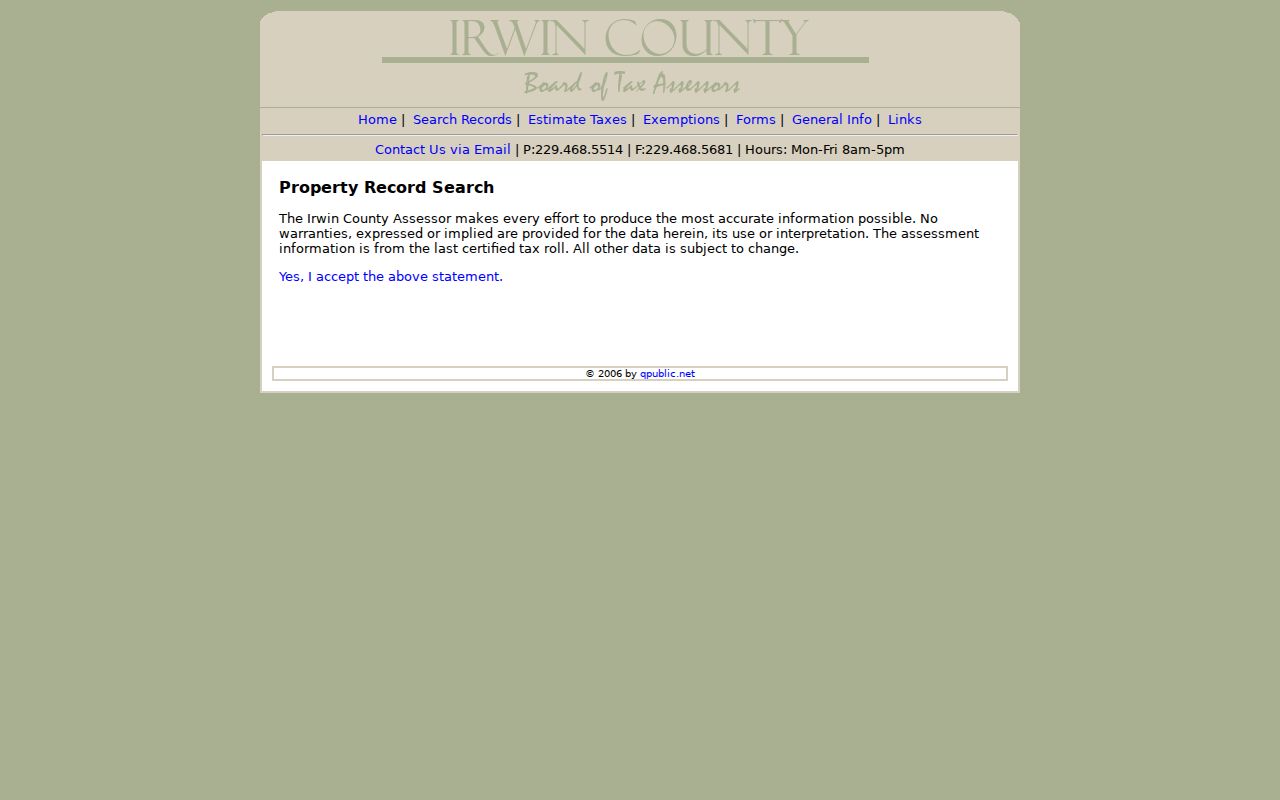
Its disclaimer reinforces why an owner answer needs a date and a deed cross-check.
Test Irwin Parcel Identity
The right name on the wrong tract is still a wrong answer. Before trusting any Irwin County property search result, compare the parcel number, situs, acreage, legal description, map shape, and any book/page reference against one another. A split, combination, correction, or road-name change can quietly sever the link. That severs it between an old deed and the current parcel card.
Rural tracts carry another wrinkle. An Irwin deed may rely on district, lot, adjoining owners, or metes and bounds rather than a street number. Early Irwin land used district-and-lot descriptions throughout. A recorded plat or survey bridges those older forms far better than a GIS map label ever can.
Boundary history adds a third risk. Land once recorded in old Irwin County may now sit inside a county carved from that territory. Chase a neighboring jurisdiction only when an instrument date, district, lot, or legal description gives a historical reason to cross the line. A matching name next door proves nothing about the subject parcel.
Use Irwin Filing Alerts
GSCCCA FANS takes name or address notification requests. It watches real-estate, lien, plat, and UCC index activity for new filings. The service looks forward only. Its terms state that a request runs one year unless renewed. It will not rebuild old ownership history.
That limit matters once a property owner is identified. An alert can flag a later deed filing for attention. It cannot certify ownership, guarantee prompt data, or substitute for the recorded image. Treat every notice as a cue. Pull the official deed records and check the index yourself.
Request Missing Irwin Owner Records
When a portal stalls, Georgia's Open Records Act gives Irwin County requesters a documented fallback. Send each custodian a narrow request for existing records. Include the parcel number, situs address, owner name variants, date range, record category, and the electronic format you want. Ask for a fee estimate and the legal basis behind any withheld or redacted portion.
Each office fills a different gap. The assessor can produce parcel cards or tax roll entries, while the Clerk can locate recorded instruments by parties, date, type, and book/page. Courthouse research remains an option too, though current hours and the Clerk's conflicting published phone numbers should be confirmed before any trip. A phone answer is only a lead. Preserve the written record itself.
Define Irwin Ownership Terms
Clear labels keep an ownership result within the proof that supports it.
- Owner of record
- The name carried in a specified official roll or recorded instrument as of a stated date.
- Grantee
- The person or entity receiving an interest through a deed.
- Situs address
- The location address of the land, which can differ from the owner's mailing address.
- Title
- The legal ownership interest, which a name search alone cannot conclusively establish.
Grade Irwin Ownership Confidence
An ownership answer is strongest when several fields line up. At the top sits a viewed recorded deed or court order. Its grantee and legal description must match the parcel. One tier down is a GSCCCA index entry with book/page but no viewed image. A certified tax roll supplies a dated owner of record label. A plan, newspaper, or catalog notice is only a lead. Keep those levels apart. A name in a plan or notice should never be upgraded to owner without a parcel-linked official record.
A one-parcel worksheet makes the test plain. Its identity row holds the entered address, normalized situs, parcel number, jurisdiction, capture date, and roll year. The deed row stores the latest grantee, grantor, instrument type, and execution and recording dates. It also holds book/page, image status, and description match. A land-use row can carry zoning, permit, or project context without letting it bleed into title. The confidence row then declares direct primary record, official index lead, official plan context, archive lead, or unverified search result.
Conflicts stay visible in this format. A roll name that differs from a newer matched deed may just signal a pending update. A deed tied to a different legal description proves nothing for the parcel. A tax-sale notice without the resulting recorded instrument remains a notice, full stop. If the evidence ends at an index summary, say so. The method answers who owns a property in Irwin County with precision. It records what was proved and what was not.
Plats and map labels deserve the same discipline. A recorded plat can tie a lot and block to a deed, while the assessor's map offers tax-oriented geometry. Neither a planning area nor the look of a fence establishes ownership. Acreage, parcel shape, or description may conflict. Then seek the recorded plat and a survey rather than settling it from a screen.
City records add context only after jurisdiction is confirmed. Ocilla keeps zoning, preservation, permit, and city project files. County offices hold the deeds, plats, assessments, and taxes. An Ocilla mailing name does not prove a parcel sits inside the city. When a city action touches the ownership question, ask City Hall for existing files by parcel and date.
For older rural land, carry district, lot, acreage, and adjoining-owner language forward from deed to deed. Early Irwin property predates modern parcel identifiers, and later county boundary changes complicate the trail. The method still starts with the present parcel, but it should stop the moment the description link turns uncertain. Historical clues belong in a separate research note until matched.
Keep the final statement short. Name the roll label, the latest matched grantee, source dates, and any conflict. Do not add an occupant, agent, taxpayer, or heir unless the record role matters and is clearly labeled.
Limit an Irwin Owner Finding
An Irwin County assessment label names the owner of record on the tax roll. It does not prove who actually lives there. A parcel number match in the deed records looks convincing. Still, unrecorded claims, court orders, liens, reservations, and title defects can sit outside what the recorder shows. Some protected details may be redacted too. So cite the property records source, the date, the image status, and whether the legal description matched, and call any finding the latest located rather than a certainty.
Lawful use. An Irwin County owner lookup supports property diligence and civic research. Never use public names or addresses to harass, intimidate, or harm anyone.
Real stakes demand more than a property search. For a sale, an estate dispute, or a boundary fight, order certified copies from the county. Bring in a qualified attorney or title professional. A recorded deed beats the tax roll as evidence of ownership. Even so, a thorough deed records review is not a title opinion.